The determination of Hajj costs should not only focus on the affordability of expenses for pilgrims departing in 2027. The government also needs to ensure that the management of Hajj funds remains sustainable and fair for the millions of pilgrims who have been waiting for years.
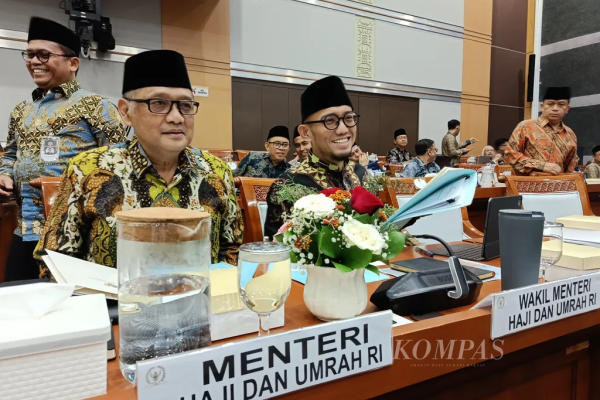
The Ministry of Hajj and Umrah has proposed the cost of organizing the Hajj pilgrimage (BPIH) for the year 1448 H/2027 H to be Rp 107.3 million for each member of the congregation. This amount represents an increase compared to the Hajj season of 1447 H/2026 M, which was Rp 87.4 million per pilgrim.
The Ministry of Religious Affairs has proposed a financing scheme where 60 percent comes from the benefits of the management of hajj funds by the Hajj Financial Management Agency (BPKH) and the remaining 40 percent is charged to pilgrims as the cost of hajj pilgrimage (Bipih).
This means that from the proposed amount of Rp 107.3 million, Rp 64.38 million is sourced from the BPKH benefit fund and Rp 42.92 million is borne by the congregation. The proposed financing from this benefit value has surged compared to 2026, where the portion covered by BPKH was only 38 percent.
"At first glance, the government's proposal to minimize costs (Bipih) as much as possible may be seen as a policy in favor of the pilgrims. However, such a scheme could jeopardize the financial sustainability of the hajj," said the Chairman of the National Hajj and Umrah Commission Mustolih Siradj in Jakarta, Wednesday (22/7/2026).
According to Mustolih, the financing scheme has the potential to threaten the liquidity of hajj funds. He provided an example, assuming the number of regular hajj pilgrims is around 203,000 people per year and the cost is approximately Rp 64.38 million per person, the funding requirement taken from the value of benefits reaches more than Rp 13 trillion.
"Indeed, the total value of benefits from the management of hajj funds is projected to be around Rp 12 trillion. This means that the benefit funds to subsidize the costs of hajj implementation are less than Rp 1 trillion," he stated. In fact, looking back at the hajj season a few years ago, the total value of benefits for Bipih was around Rp 7 trillion.
As information, the benefit value is the funds resulting from the development and optimization of hajj finances by BPKH through various investment instruments. These hajj funds are sourced from the initial deposits of pilgrims amounting to Rp 25 million per person, not from the state budget (APBN). By 2025, the total funds managed by BPKH will reach Rp 180.7 trillion.
Mustolih stated that if all the funds from the value of the benefits are used to subsidize the pilgrims who will depart next year, more than 5 million prospective members of the congregation will be affected. "Will they receive similar subsidies as those who will depart next year?" he said.
The distribution of benefits must be fair, including to pilgrims whose turn it is to perform the Hajj later.
In fact, they also have the right to enjoy benefits when they intend to perform the Hajj, in addition to the virtual account or benefits received by prospective pilgrims each year. Moreover, many pilgrims have to wait more than 20 years to perform the Hajj.
"The distribution of benefits must be fair, including for congregants whose turn to perform the pilgrimage comes later," he stated. In the Law on the Implementation of Hajj and Umrah Number 14 of 2025, Article 2, fairness is one of the principles in the organization of the pilgrimage.
In fact, he stated that Indonesia needs to learn from Tabung Haji, the pilgrimage organizing institution in Malaysia, regarding the use of benefit values. "There, the provision of pilgrimage financing subsidies is tiered according to the economic groups of the pilgrims, so it is not uniform," he said.
According to Mustolih, the benefits derived from the management of hajj funds can indeed alleviate the burden on pilgrims. However, its portion should be gradually reduced to maintain the health of the hajj funds.
After reaching nearly 60 percent in 2022, the portion of benefits in the hajj financing scheme was subsequently reduced to around 38 percent in the last two hajj seasons. Now, the government has proposed an increase back to 60 percent.
The Indonesian Ulema Council (MUI) also urged the government to return the Hajj financing scheme to the principle of istitha'ah. This principle states that the Hajj is obligatory for Muslims who are physically, mentally, and financially able.
This means that a person who performs the pilgrimage is essentially financially capable and not overly reliant on the value of benefits or subsidies. The Vice Chairman of MUI KH Cholil Nafis believes that the subsidy scheme actually obscures the principle of capability, which is a valid requirement for the obligation to perform the pilgrimage.
"Going on the Hajj is obligatory for those who can afford it. Allah does not require those who cannot afford it to go on the Hajj," said KH Cholil, as quoted from the official MUI website, Friday (10/7/2026).
M Syafii Antonio, a professor of Islamic economics at Tazkia University, Bogor, assesses that the hajj financing scheme with subsidies from the benefit value is a short-term populist policy. In fact, the management of hajj funds should be long-term considering that there are still other generations waiting in line.
Moreover, if the Government of Saudi Arabia increases the capacity for Hajj visits from around 1.7 million people per year to 5 million by 2030. As the country contributing the largest number of pilgrims, Indonesia has the potential to receive an additional quota. However, on the other hand, there are risks associated with financing.
"If the actual cost of Hajj reaches Rp 90 million per person and around 5.4 million members of the congregation are requested to depart, the total funding requirement reaches approximately Rp 486 trillion. Meanwhile, the managed funds for Hajj are still far below that figure," said Syafii.
Therefore, he stated, it is important to maintain liquidity and the management results of hajj funds so that they are not depleted to cover the costs of departures each year. Syafii also urged the government not to implement populist policies, but to emphasize a benefits or service-oriented approach.
According to him, the costs of various components in the organization of the pilgrimage continue to rise each year. Moreover, conflicts in the Middle East have triggered a surge in crude oil prices. Consequently, the costs of the pilgrimage automatically increase. This demands an enhancement of services to the pilgrims.
"It's impossible for hajj costs to be continually reduced every year to provide good service. Good service requires adequate funding," he said. That's why a service-based approach to hajj financing is more relevant than subsidies.
The issue of Hajj cost subsidies has also become a public concern, as recorded in the results of the Kompas Research and Development survey (Kompas.id) on April 16-23, 2026. This survey, which used a random sampling method, was conducted in 38 provinces involving 1,200 female and male respondents aged 17-65 years.
This survey captured that the majority of respondents (91.5 percent) were unaware that prospective pilgrims receive subsidies from the benefits of managing hajj funds. Among the 8.5 percent of respondents who were aware of this, they believed that the subsidies provided should be a maximum of only 20 percent.
The Minister of Hajj and Umrah, Mochamad Irfan Yusuf, when met in Jakarta on Tuesday (14/7/2026), stated that the proposal to increase the cost of Hajj is inseparable from changes in Hajj services from Saudi Arabia, the strengthening of the dollar against the rupiah, and the rising costs of flights due to global pressures.
That is why his party proposed that the portion borne by the congregation be only 40 percent to minimize the financial burden. Nevertheless, this proposal will be discussed in the Hajj Working Committee at the DPR. "It will be discussed one by one to ensure whether the figure (Hajj costs) is reasonable or needs to be reduced or perhaps even increased," said Irfan.
The Vice Chairman of Commission VIII of the DPR, Fikri Abidin, stated that the Hajj Working Committee of the DPR is targeted to begin its work in mid-August 2026. The committee will analyze which components have experienced increases in accordance with the proposed costs for Hajj organization from the Kemenhaj.
"We will later see whether the proposal from the Ministry of Religious Affairs ensures the liquidity of the BPKH or not. Because, the funds of the pilgrims must be considered with fairness, especially for prospective pilgrims who are in line," said the politician from PDI Perjuangan.
According to Abidin, the determination of hajj costs requires in-depth discussion as it pertains to the sustainability of hajj financial management. "Furthermore, the hajj costs must be commensurate with the services received. We also do not want the costs to be low, but to the detriment of the pilgrims," he stated.
A member of the BPKH Executive Board, Amri Yusuf, stated that since 2023, the composition of the benefit value for pilgrims set to depart has been gradually reduced to maintain the sustainability of hajj funds. Ideally, he said, the reduction in the portion of the benefit value is 5 percent per year.
"Indeed, in our simulation, if the composition of the subsidy (its value) is below 30 percent, the financial management of hajj could last for up to 100 years," he stated.
The Head of the BPKH Executive Agency, Fadlul Imansyah, stated that the benefit value of the hajj funds amounting to Rp 12 trillion is not solely for the 203,000 congregation members who will depart next year. "However, the hajj funds should also be reserved for the benefit value as a result of investments for the 5.6 million congregation members who are waiting," he said.
Ultimately, the determination of hajj costs is not merely about finding affordable fares for prospective pilgrims who will depart next year, but rather how to ensure the sustainability of hajj funds. This is because maintaining the financial continuity of hajj means preserving the trust across generations.